Something happened recently that I haven't been able to stop thinking about.
Someone I know was sharing a view they held — confidently, for years. I asked, almost casually, where it came from. They paused. Longer than expected. Then admitted they weren't sure. They'd just always thought that. It had always felt like theirs.
I've been on that side of the pause too. More than I'd like to admit.
We inherit worldviews the way we inherit eye color. Silently. Without a moment of consent. The school you went to had a particular slant. The books that were celebrated in your house carried certain assumptions. The friend group you found yourself in during a formative few years — they had opinions, and those opinions got into you through osmosis, through repetition, through the simple fact that you were there and impressionable and not yet paying attention.
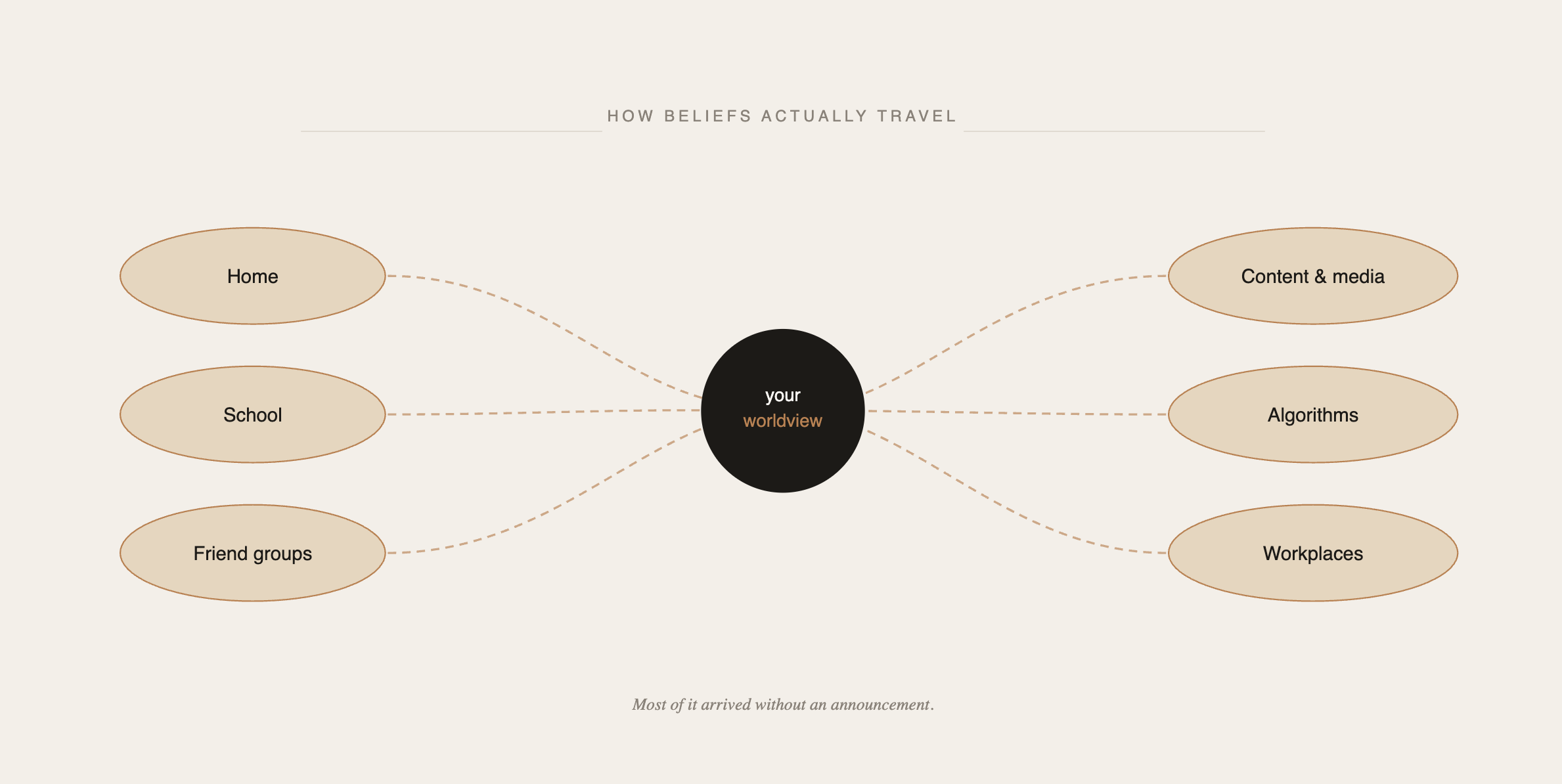
The Prefab Identity Problem
Once I started looking for this pattern, I couldn't stop seeing it.
Most tribes — ideological, professional, cultural — aren't really communities of inquiry. They're brands. And what they're offering is a prefab identity. Plug it in, let it run, get on with your life. No assembly required.
It feels safe. It's meant to.
It shields you from the stomach-lurching possibility that some of what you've always believed might not just be wrong — but was never yours to begin with.
Here's the question that follows: if you never pull apart the narratives you were handed, can you call any of your beliefs yours? Or are you just the latest owner of a family heirloom — dusted off, slightly rearranged, relabeled as original thought?
I find that uncomfortable. Which is probably why it's worth sitting with.
The Quiet Work
Building your own worldview doesn't look like a dramatic break. No manifesto moment. No door-slamming.
It's slower than that. It looks like going back to something you believe and asking: where did this actually come from? Did I work this out, or did it just arrive and I forgot to question it?
I'll give you one from my own life. For years I held a fairly fixed idea of what a good career looked like — the progression, the title arc, the steady upward line. I thought I believed in it. But when I actually traced it back, it wasn't something I'd concluded. It was something I'd absorbed — from watching what got celebrated around me growing up, from the college environment I was in, from a genre of ambition that was in the air during my 20s and that I breathed in without realizing.
Noticing that was uncomfortable. Not because the belief was necessarily wrong — but because I'd been treating it as mine when it was actually borrowed.
That's the work. Distinguishing between what you concluded and what you inherited. It sounds simple. It isn't.
Why Most People Don't Bother
The honest answer: it's not required. You can go a whole life without doing this and be perfectly fine. Socially smoother, even.
But something quietly happens if you don't: you end up a permanent tenant in someone else's house. You mistake comfort for truth. And you spend years not quite understanding why certain parts of your life feel like they belong to someone else — like you're running on scripts that were written for a slightly different character.
Questioning inherited beliefs is, in a strange way, one of the most countercultural things you can do. Every algorithm nudges you toward predictable opinions. Every social incentive says pick a team and stay there. Uncertainty isn't rewarded — having a clear position is.
So yes, it will at times feel lonely. You'll look at people who seem so certain about everything and wonder if you made a mistake by questioning anything at all. I still wonder that.
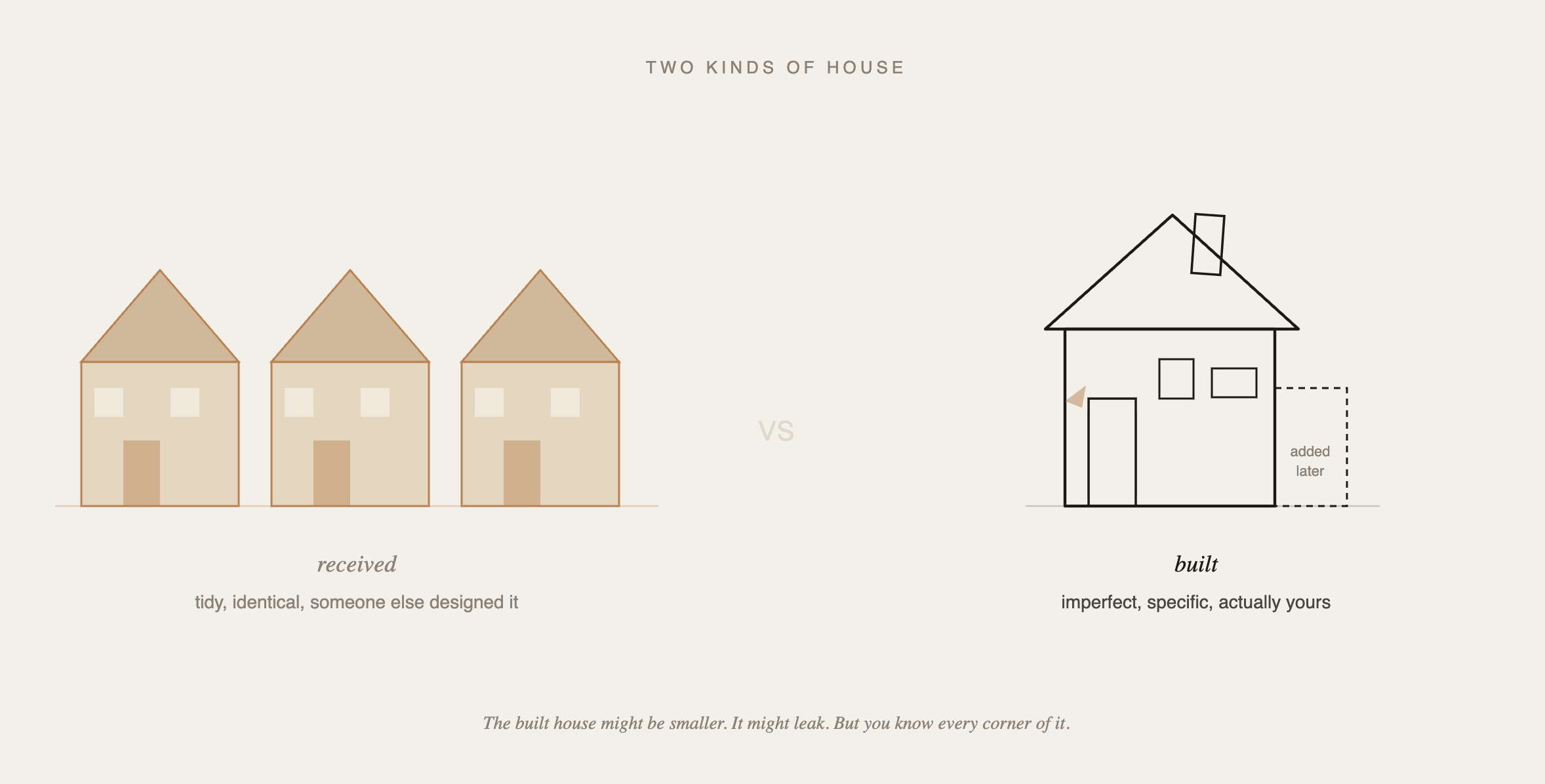
But there's a specific feeling that comes from ideas you've actually worked through — tested, discarded, rebuilt. Not confidence exactly. More like coherence. Like standing in a house you built yourself. It might be smaller than the ones around it. It might have odd angles. But you know which floor creaks, and why, and you put it there.
I don't think this is something you finish. There's no moment where you've fully constructed yourself and can stop examining. The discipline is in the revising. The humility is in admitting where you're still running on inherited scripts — and most of us are, somewhere.
I'm still figuring most of this out.
One thing I've started doing differently, though: I'm more deliberate about who I spend time with.
I find myself gravitating toward people who ask a lot of questions — not to be difficult, but because they're genuinely unsure. People who'll say "wait, but why do you think that?" and mean it. Those conversations are uncomfortable in a way that's useful. Someone pushing back on a belief I hold, or questioning one of their own out loud — that's where something real tends to surface. Not agreement. Just clarity.