Every now and then, someone sends me a screenshot or link with zero context. Just the image, in a WhatsApp group. No "check this out," no explanation. Just the thing.
That's the highest form of sharing. Not a like, not a bookmark, not a reshare with a comment. The screenshot-and-send with no words attached. Because the thing said everything already.
I've been trying to figure out what those things have in common — the ones that actually travel. Not just accumulate likes. Actually travel — forwarded, pasted into group chats, read aloud to someone across the table.
The pattern I see: they give someone language for something they already felt but hadn't figured out how to say. The last time I shared something, it wasn't because I thought the creator was brilliant. It was because the thing said something about me. Maybe others also feel the same when they share.
That's the insight most people miss.
The three triggers
From what I can tell, shareable things tend to hit one of three nerves. Maybe two at once if you're lucky. I haven't seen anything reliably hit all three — that might be the platonic ideal of a piece of content that nobody will actually read because it's too accurate.
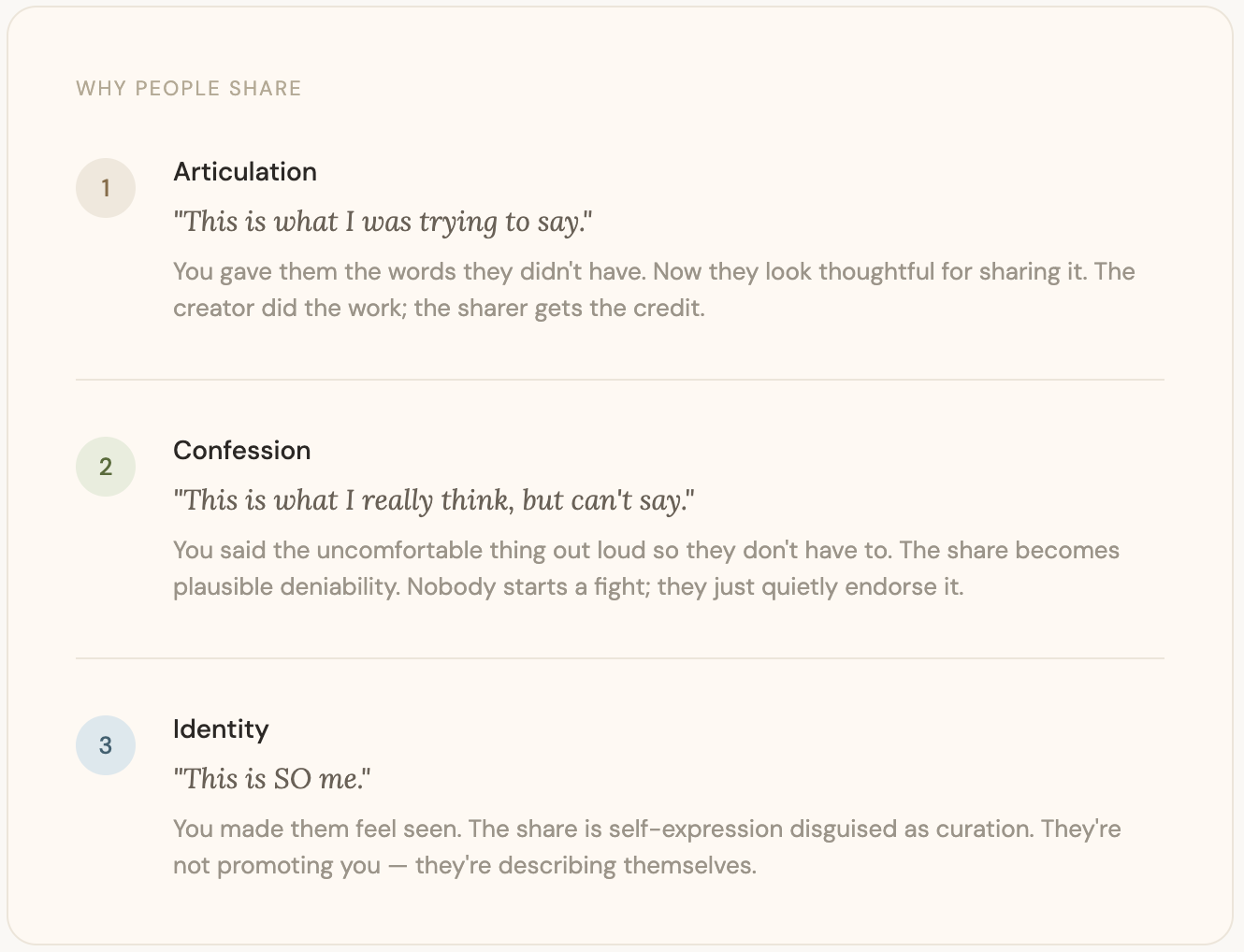
When something hits even one of these, it stops being content. It becomes a tool. People don't share your work to promote you. They share it to say something about themselves. The creator is just the delivery mechanism.
I find that slightly humbling and also clarifying. Because once you see it, you can't unsee it.
It's not just writing
The same logic applies to products — and this is where I've been sitting with it more lately.
Think about the products people actually recommend to friends. Not the ones with the longest feature list. The ones where using it makes you feel like someone finally gets it. The ones where the experience is so specific, so opinionated, that telling someone about it feels like letting them in on a secret.
Nobody shares a product because it has 47 integrations. They share it because it made them feel something — understood, capable, ahead of the curve. If it doesn't give someone an emotional reason to bring it up in conversation, it doesn't matter how good the engineering is.
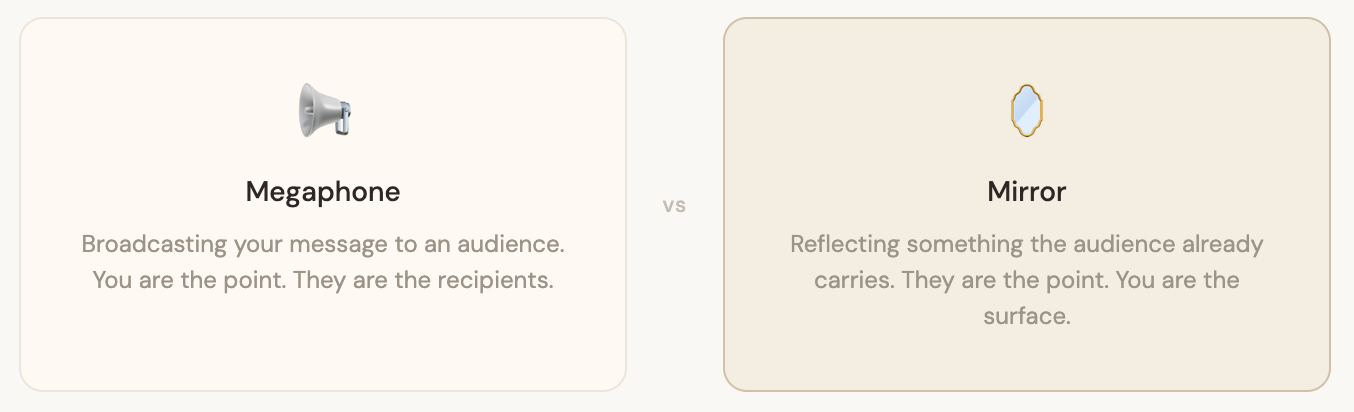
And yet most products are built as if distribution is a logistics problem. Add a referral program. Add a share button. Optimize the funnel. None of that matters if there's no emotional fuel underneath.
The trap of doing too much
There's a related problem that's getting worse right now, especially as it's never been easier to ship. Background agents, vibe coding — you can build in a weekend what used to take a quarter. So everyone's building more.
More features, more surface area, more options. It feels productive. I've been guilty of this impulse too — the checklist of things we haven't built yet, the roadmap that keeps getting longer.
But doing too much muddies the story. People can't explain what you are in one sentence. And if they can't explain you, they can't share you.
A narrative so crisp that someone can relay it at a dinner table without pulling out their phone. The best products stay loyal to a single first-order idea. They don't stack features like cargo. They understand that restraint is what makes the story tellable.
The Final Thoughts
The urge right now is to show how much you can do. But the move — in writing, in products, in anything you put out — is to show how much you understand.
Those are different things. One is a list. The other is a point of view.
I'm still working out what this means practically. Probably it means saying no more than yes. Probably it means the version that feels slightly too small is closer to right. Probably it means the features you cut matter as much as the ones you ship.
But here's what I keep coming back to: does this help someone say something they couldn't say on their own? If yes, it travels. Not because of algorithms. Because humans are wired to share things that represent them.
That's the question worth sitting with. Not "how do we grow this" — but "does this give someone a reason to bring it up?"